
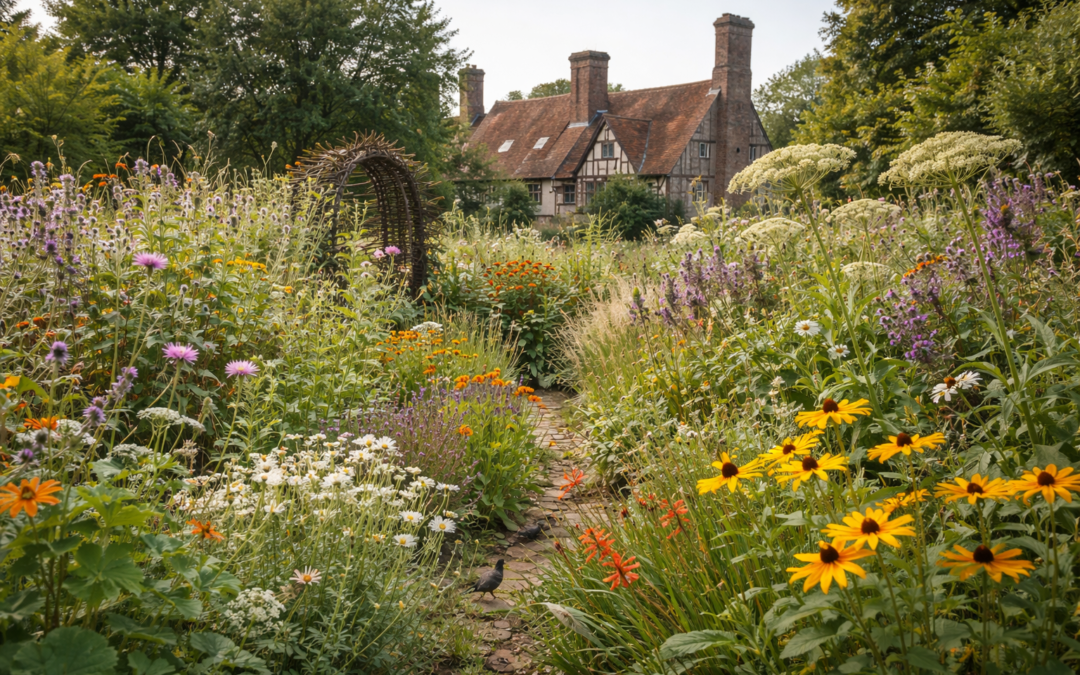
Recently we listened to a podcast interview (1) in which Doug Tallamy described the ecology of the British Isles as something like “wallpapering” — landscapes that look pleasant but support relatively little insect life.
It’s a familiar metaphor Tallamy often uses – you cannot build a house out of wallpaper. His study showed that about 14% of native trees and woody shrubs form a foundation on which caterpillars are raised and which feed chickadees. Remove those “right plants”, he argued, and the entire ecological house collapses.
Many ecologists cite Tallamy’s study – that some trees and woody shrubs do support large numbers of insect herbivores, particularly the larvae of moths and butterflies.
Within the 14% are large trees such as oaks, willows, and birches which are well known for hosting many caterpillar species. These insects are valuable food for birds raising their young.
British Isles landscapes have many of these very plants Tallamy describes as ecological “keystones.” Oaks, willows, birches, and cherries grow across the countryside, in woodlands, hedgerows, parks, and gardens. These genera are not rare curiosities in Britain and Ireland. They are everywhere (2)(3). Oak woodlands remain a defining feature of the landscape. Willows line rivers and wetlands. Hedgerows form long corridors of shrubs and trees that support insects, birds, and small mammals. In summer they hum with life.
In other words, the ecological “foundation plants” that Tallamy highlights as crucial for supporting caterpillars – and therefore birds – are already deeply embedded in the vegetation of the British Isles. This raises a question for gardeners: if these plants are already widespread across the landscape, what additional factors are shaping the wildlife we actually see?
Anyone who has watched birds feeding their young quickly notices that caterpillars are only part of the menu. Parent birds bring back a wide variety of prey – spiders, flies, beetles, small moths, crane flies, and other soft-bodied insects. In many cases, spiders form a sizeable part of the diet, particularly early in the season when caterpillars are scarce.
The food web that sustains birds is therefore not a narrow pipeline running from one type of plant to one type of insect. Caterpillars may be important in some moments and places, but they are far from the only thread holding the system together. It is a branching network of many interacting organisms.
Gardens often reveal this complexity very clearly. A robin pulling grubs from the lawn, a tit collecting spiders from the bark of a shrub, or a wren hunting tiny insects among dense foliage are all taking part in the same food web.
Indeed, the British Isles are not pristine ecosystems. Agriculture, urban development, and land management have profoundly altered them. These landscape changes have altered insect life. Yet these landscapes have also evolved into a mosaic of habitats—woodlands, hedgerows, pastures, wetlands, orchards, and gardens. Throughout the two islands, wilderness areas still exist. They are living environments where ecological processes continue, even if the species mix has changed over time.
Ecosystems in practice are not rigid. They are more like old market towns. Buildings get replaced, extended, and renovated over generations. Some shops close, new ones appear, and the streets are still lively even though the skyline changes. Nature works equivalently. Species arrive, adapt, and rearrange themselves within the spaces available.
Ecologists increasingly recognize that many modern landscapes are mixtures of long-established native species and plants that arrived later through cultivation or trade. Over time these communities reorganize and continue functioning in new ways. Pollinators still move through flowering plants, birds still feed their young, seeds disperse, and soils remain active with countless organisms. Some researchers describe these evolving communities as “novel ecosystems,” but most gardeners simply experience them as living landscapes that continue to support wildlife even as the species mix changes.
None of this means the novel ecology story is entirely comfortable. Biodiversity loss is real, and many species have declined. Conservation efforts – including the protection and planting of native species – play an important role.
But describing the ecology of an entire region as “wallpaper” risks overlooking something fundamental: living systems are remarkably resilient. They reorganize, adapt, and persist even within landscapes that have been altered by people.
The ecological house may not look exactly as it did centuries ago. Some rooms have been remodeled, and the wallpaper may indeed have changed. But the lights are still on, and life continues to move through the halls. Anyone who has spent time in the British Isles knows that the countryside, villages, and gardens are not silent places.
For gardeners, this doesn’t reduce the value of plant choice — but it does suggest that structure, habitat features, and how a garden is managed may be just as important in shaping what lives there.
Seen from this perspective, describing the ecology of the British Isles as a “failed food web” may understate how much ecological activity is still present in these landscapes.
(1) https://www.thomaschristophergardens.com/podcasts/native-vs-exotic-plants-support-for-insect-populations (start at 23 seconds)
(2) https://www.woodlandtrust.org.uk/blog/2018/12/what-are-the-most-common-trees-in-the-uk/
Key research supporting the ecological value of UK gardens
A. One of the most influential studies of garden ecology.
https://impact.ref.ac.uk/casestudies/CaseStudy.aspx?Id=11853&utm (1999-2007)
Researchers found domestic gardens are “a nationally important ecological resource” for biodiversity in cities.
The study showed that the extent of gardens and the biodiversity they support make them major contributors to urban conservation.
B. Urban Domestic Gardens (Thompson et al. 2003)
This work found that garden plots contained more than twice as many plant taxa as other habitats sampled in the study.
https://www.researchgate.net/publication/242658630_Urban_domestic_gardens_I_Putting_small-scale_plant_diversity_in_context
Importantly, the flora was a mix of native and non-native plants, showing that high biodiversity can exist in mixed planting environments.
C. Urban Domestic Gardens IV – Gaston et al. (2005)
This research demonstrated that domestic gardens form a substantial proportion of urban green space, covering about 23% of the urban area of Sheffield.
https://link.springer.com/article/10.1007/s10531-004-9513-9
Because gardens are numerous, they collectively become a large ecological resource within cities.
Recent Comments