
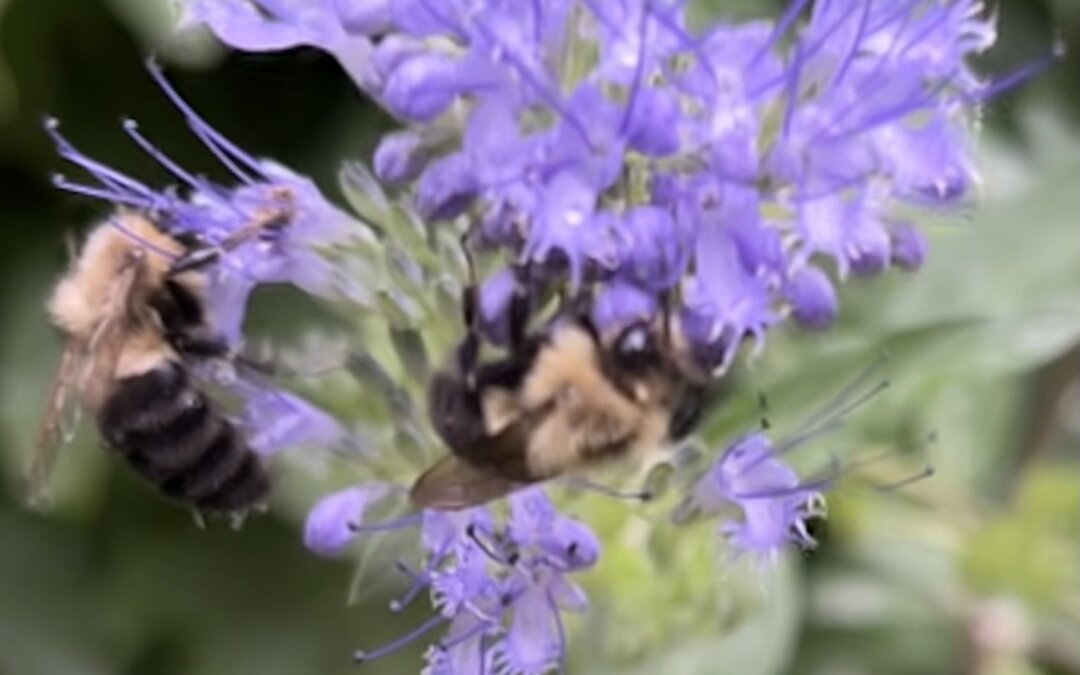
Who Actually Lives in Toronto Gardens?
A concise, context-based snapshot for dense urban settings by Dorothy & Patrick Smyth
Urban ecology research shows that insect communities in Toronto vary strongly by location, scale, and connectivity. Gardens matter — but their ecological role depends on context.
1. What is typically present in dense urban neighbourhoods?
In the urban core, insect communities are typically dominated by generalist and disturbance-tolerant species (many of which are native), including:
- Generalist bees (bumblebees, sweat bees, honey bees)
- Flies (hoverflies, gnats)
- Ants and ground beetles
- Aphids and leafhoppers
- Cabbage white butterflies
These species:
- tolerate heat and disturbance
- use a wide range of plants
- persist in fragmented landscapes
Urban gardens often show high insect activity, even when species diversity is moderate.
2. What is often limited or absent?
Harder to sustain in dense urban settings:
- Specialist butterflies and moths requiring specific host plants
- Species dependent on large, connected habitat patches
- Insects requiring undisturbed soil or leaf litter to overwinter
- Area-sensitive or disturbance-intolerant species
These limitations occur even in well-planted gardens.
3. Why outcomes differ across the city
Key urban constraints (largely beyond individual control):
- Small, isolated habitat patches
- Roads and buildings reducing connectivity
- Urban heat island effects
- Artificial light at night
- Frequent disturbance and “tidying”
- Compacted or altered soils
These constraints apply in addition to plant choice and plant origin.
4. How insect communities change by landscape context
A consistent gradient is observed:
- Dense urban core:
- High activity
- Moderate species richness
- Dominated by generalists
- Suburban landscapes:
- Higher species richness
- Some life-cycle completion
- Rural / large natural areas:
- Highest diversity
- Specialists present
- Stable population persistence
Species richness increases with habitat size and connectivity.
5. What gardens can do
Urban gardens can:
- Increase local insect visitation and abundance
- Provide nectar, pollen, and some host plants
- Improve structural complexity
- Reduce harm (e.g., pesticide avoidance)
- Contribute stepping-stone permeability for some urban-tolerant species
- Support public awareness and stewardship
- Planting native and host plants can increase resources for certain species, particularly near larger connected natural areas.
6. What gardens cannot do alone
Individual gardens cannot reliably:
- Overcome landscape-scale fragmentation
- Substitute for large connected habitats
- Ensure specialist persistence in isolation
- Reverse regional biodiversity decline on their own
Necessary conditions (e.g., host plants) are not always sufficient conditions for population recovery in dense urban settings.
Long-term biodiversity outcomes depend primarily on:
- Habitat size
- Connectivity
- Reduced disturbance
- Surrounding land use
These are addressed most effectively through larger connected systems such as ravines and natural heritage areas.
7. Why this matters
Understanding gardens within an urban-gradient framework:
- Supports realistic, non-moralized expectations
- Aligns with City biodiversity planning (which differentiates habitat types)
- Clarifies where native planting has greatest impact
- Recognizes the difference between increasing activity and supporting persistence
Gardens are contributors within a larger system — not substitutes for it.
Alignment Statement
This summary reflects peer-reviewed urban ecology research and is consistent with the City of Toronto’s policy-level approach to biodiversity, which recognizes that ecological function varies by scale, connectivity, and urban context.
Evidence Base: Insects, Urban Gardens, and Ecological Constraints in Toronto
This appendix summarizes peer-reviewed and authoritative sources that inform the accompanying discussion handout Who Actually Lives in Toronto Gardens? It is provided for reference and record-keeping and is not intended to prescribe garden practices.
1. Urban insect communities follow a gradient, not an on/off pattern
Ayers, A.C. & Rehan, S.M. (2023)
Bee–plant interaction networks along an urbanization gradient
Journal of Urban Ecology, 9(1) – https://doi.org/10.1093/jue/juad010
- Studied bee communities and plant–pollinator interactions across 29 sites along a Toronto urbanization gradient.
- Found that increasing urban intensity simplifies bee communities and interaction networks.
- Generalist bee species dominate in dense urban settings; specialist species decline with urbanization.
Key point:
Urban gardens can support many insects, but community composition shifts predictably with urban land use.
2. Host plants help, but landscape context remains a strong filter
Gordon, D.R. & Kerr, J.T. (2025)
Urban butterfly metacommunities in Ontario
Journal of Urban Ecology, 11(1) – https://doi.org/10.1093/jue/juaf006
- Examined butterfly diversity across peri-urban, suburban, and urban landscapes in Ontario.
- Butterfly richness declined with increasing urbanization.
- Host plant richness contributed positively, but impervious surface and habitat connectivity strongly constrained outcomes.
Key point:
Local planting matters, but broader landscape conditions strongly influence which insect species persist.
3. Cities favor generalist insects; specialists are filtered out
Remmers, S.J. et al. (2024)
Bees in urban ecosystems: a global synthesis
npj Urban Sustainability – https://doi.org/10.1038/s42949-024-00133-7
- Global synthesis of urban bee studies.
- Cities often support high bee abundance and moderate species richness.
- Urban environments consistently favor generalist traits; specialist species are less likely to persist.
- Natural and semi-natural landscapes support the highest diversity and most complete life cycles.
Key point:
Urban environments support insect activity, but not all species respond equally to city conditions.
4. Scale and connectivity shape ecological outcomes
Aronson, M.F.J. et al. (2017)
Biodiversity in the city: key challenges for urban green space management
Frontiers in Ecology and the Environment – https://doi.org/10.1002/fee.1480
- Highlights the importance of habitat size, connectivity, and surrounding land use in shaping urban biodiversity.
- Notes that small, isolated green spaces function differently from larger, connected habitats.
Key point:
Ecological function at garden scale is constrained by fragmentation and isolation, regardless of planting intent.
5. Toronto-specific context: ravines vs. residential landscapes
City of Toronto – Ravine Strategy & Monitoring Reports – Not peer-reviewed
https://www.toronto.ca/wp-content/uploads/2017/10/8fd6-RavineStrategy.pdf
Recent Comments