
Upon reading “Humanity for Habitat”
A review by Dorothy & Patrick Smyth
Why scale ultimately breaks the argument for urban gardens
Upon reading “Humanity for Habitat: Residential Yards as an Opportunity for Biodiversity Conservation” (BioScience, 2023), it is easy to understand why the paper has attracted attention. The authors frame residential yards — urban, suburban, and rural — as collectively significant spaces that could support biodiversity and strengthen people’s connection to nature. Their synthesis of urban ecology research is careful, well written, and grounded in peer-reviewed literature.
At first glance, it offers a reassuring message: that everyday spaces matter, and that gardeners are not powerless.
That framing resonates strongly with many of us working in urban gardening education. It pushes back against despair, acknowledges human presence in ecosystems, and avoids simplistic claims that gardens can “replace” intact natural areas. So far, so good.
Opportunity is not the same as relevance
The paper’s central claim is that residential yards represent an opportunity, not a solution, for biodiversity conservation. That distinction is important, and in principle correct. Gardens occupy a substantial proportion of green space in many regions, and management choices can influence local ecological conditions.
But which gardens, and at what scale, turns out to be decisive.
Urban ecology is scale-sensitive. Claims that hold at one spatial scale often collapse at another. This is not a philosophical point — it is a basic property of ecological systems. And this is where caution is required.
The line that gets repeated — and misused
A phrase frequently drawn from the urban ecology literature is that “local management can lead to detectable changes in local species presence or abundance.” In outreach contexts, this is often interpreted as encouragement, or even obligation.
In fact, it is a descriptive statement, not a prescription
In small urban gardens, what people do mainly affects what shows up locally — plants, insects, birds — not the trajectory of biodiversity at the city or regional level. That distinction has long been emphasized by those of us working within the framework of urban ecology.
Up to this point, there is no real disagreement between the paper and that position.
The paper leans on bird–insect studies — cautiously
The paper draws heavily on Narango et al. (2018), which examined Carolina chickadees in residential landscapes and measured how plant composition influenced insect availability, particularly caterpillars. Under certain conditions, yards with higher native plant biomass showed higher insect abundance, and modeled estimates of population growth sometimes overlapped replacement.
Importantly, the authors present these findings carefully: with confidence intervals, modeled outcomes, and explicit uncertainty.
They do not claim that all gardens function as source habitat, nor that small urban gardens reverse bird declines.
Still, this work is frequently summarized in simplified form as evidence that gardens can “support bird populations.” Whether that extrapolation is justified depends entirely on scale.
And this is where the paper’s own assumptions become impossible to ignore.
Where the argument quietly breaks: yard size
The real problem emerges when the paper attempts to quantify the ecological “capacity” of residential yards.
In Table 1, the authors report an average urban yard size of 0.33 hectares.
Pause here.
• 0.33 ha = 35,500 ft² ≈ 0.82 acres
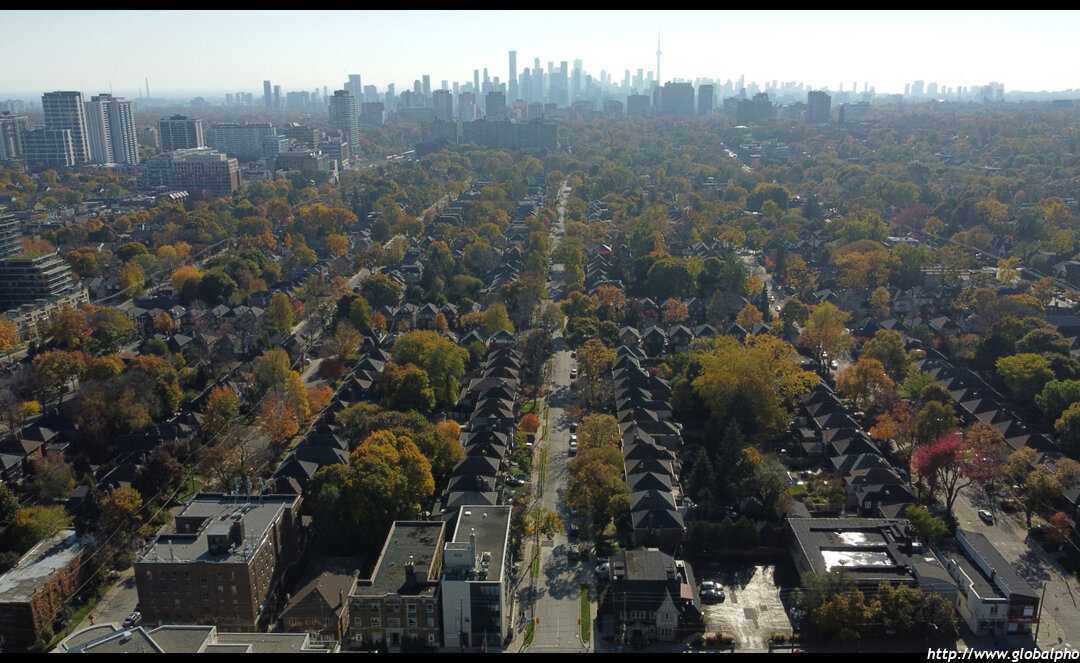
That is not an urban garden in Toronto.
It is not even typical of most GTA suburbs.
It is larger than many exurban lots in southern Ontario.
• A typical (average) urban Toronto lot is about 4,400 ft² (~0.04 ha)
• Many GTA suburban lots fall between 2,600 and 4,400 ft²
The paper’s “average urban yard” is 8–13 times larger than what most Toronto gardeners actually have. This is not a rounding error. It is an order-of-magnitude mismatch.
Why this happens — and why it matters
The 0.33 ha figure is derived from US-wide, density-based parcel averaging, using 1 km² census grids and assumed yard sizes applied across a very broad “urban” category. That category includes many low-density US cities where detached lots are large by Ontario standards.
In other words, the number is a continental accounting construct: not a reflection of lived urban form in many dense cities. The paper never flags this clearly, and the diagrams strongly invite misinterpretation.
Once that inflated yard size is accepted, a cascade of claims becomes easier to make:
• that yards rival protected areas in area
• that food webs can be “completed” at yard scale
• that individual gardeners meaningfully support bird populations
Those claims do not survive contact with real Toronto lot sizes.
Why this matters for urban gardeners in Toronto and Ontario
This is not an academic quibble. It goes to the heart of how we communicate with the public. When studies built on exurban-scale assumptions are used to frame advice for urban gardeners, we:
• misrepresent the science
• inflate expectations
• and subtly shift responsibility from systems to individuals
Urban home gardeners are being asked to respond to ecological claims that assume yards they do not have, and never will. That erodes trust — not only in particular studies, but in ecological guidance more broadly.
A necessary conclusion
The uncomfortable truth is this: Once the yard-size assumption is exposed, Humanity for Habitat ceases to be a useful foundation for guidance aimed at urban gardeners.
The paper may still have value for:
• suburban and exurban land-use discussions
• policy-scale land accounting
• conversations about human–nature relationships
But as a basis for messaging to dense urban gardeners, such as in Toronto, it is fundamentally mis-scaled. Urban ecology demands honesty about limits. Urban gardeners deserve information grounded in the spaces they actually occupy — not in diagrams built on inflated averages.
References
Humanity for Habitat: Residential Yards as an Opportunity for Biodiversity Conservation (BioScience, 2023) https://academic.oup.com/bioscience/article/73/9/671/7289288
Nonnative plants reduce population growth of an insectivorous bird (PNAS, 2018) https://www.pnas.org/doi/10.1073/pnas.1809259115
Recent Comments