
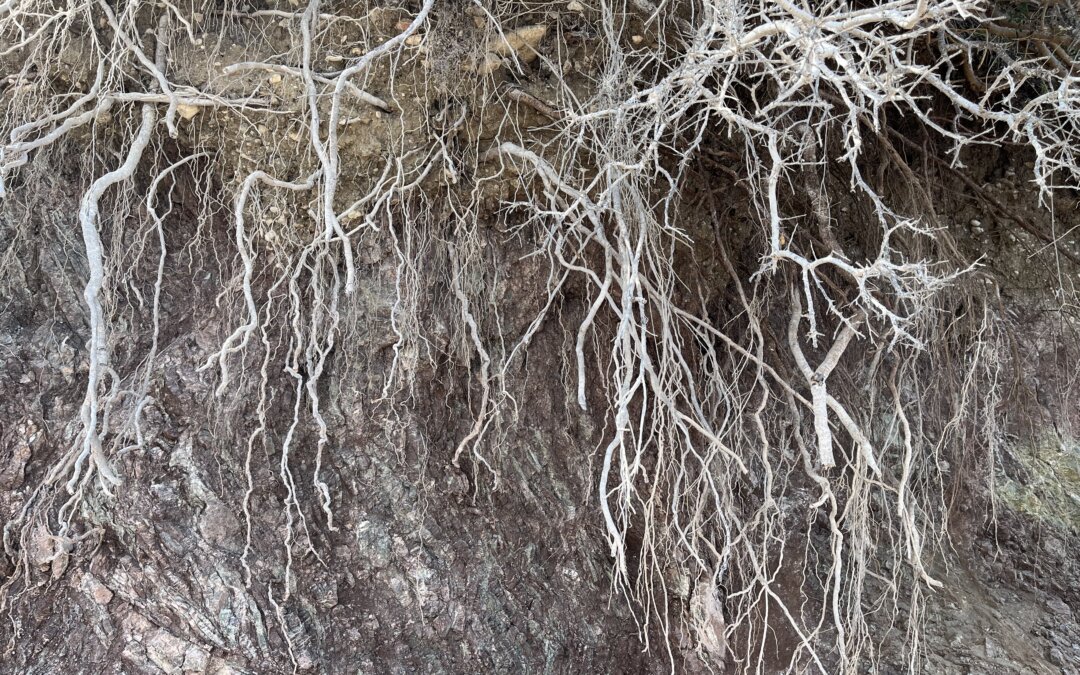
Do Native Plants Always Have Deeper Roots? A
Nuanced, Evidence Based View
It is often claimed that “native plants keep soils cooler and damper during heat waves
because they have deep root systems that access groundwater.” This statement is appealing,
but peer reviewed research shows the reality is more complex.
1. Deep roots are not exclusive to native plants.
Research shows that deep rooting occurs widely across many species, native and non native alike.
• Pierret et al. (2016) demonstrate that deep root systems are determined by soil conditions and functional traits, not plant origin.
2. Nativeness is not a reliable predictor of water use or cooling effect.
• Cavaleri et al. (2014) found that some native trees use water more conservatively than invasive species, but results vary by species and do not confirm that natives always keep soils cooler.
• Tartaglia & Aronson (2024) reviewed urban landscapes and concluded that evidence for hydrological benefits of native plants is mixed and context dependent.
3. Soil structure and site conditions matter more than nativeness.
Rooting depth is strongly shaped by:
• soil compaction
• texture (clay, sand, silt)
• organic matter
• mycorrhizal networks
• irrigation practices
A non native plant in good soil often develops deeper roots than a native plant in compacted urban fill.
4. A gentle, accurate message for gardeners:
“Some native plants do develop deep roots, but root depth depends far more on soil structure
and species traits than on nativeness alone. If our goal is cooler, moister soil during heat
waves, the best approach is to improve soil structure, reduce compaction, and choose
species—native or otherwise—well adapted to the site.”
Key References
• Pierret A. et al., 2016 — Frontiers in Plant Science
• Cavaleri M.A. et al., 2014 — Conservation Physiology
• Tartaglia E. & Aronson M.F.J., 2024 — Urban Ecosystems
Recent Comments